The comparative military strengths of the U. S. and Iran was never an issue. The U.S. knew it could blow more stuff up. But that hasn’t been enough to “win” if by win you mean getting a new regime in Iran willing to agree to all of the U.S.’s demands. Iran turned out not to be another Venezuela. Why might this war last a lot longer than we all hope?
Trump thought it could quick and somewhat painless; that an intimidating military force threatening Iran would allow a deal to be made. That’s his way of operating. Apply maximum pressure, make maximum demands and negotiate from there. Fine for a real estate deal I guess, though I’ve always thought the best deals were win/win. Trouble is, once that force was assembled not using it would have been a big win for Iran.
Below I’m going to outline the circumstances we and Iran now find ourselves in. I have no top secret clearance or access to information anybody else can’t get. The geography of Iran and the Middle East, the importance and vulnerability of the Strait of Hormuz, the nature of a Shia based religious government and Iran’s history is all public information. Even Trump and his advisors, if any, can get it. But it doesn’t seem to have mattered.
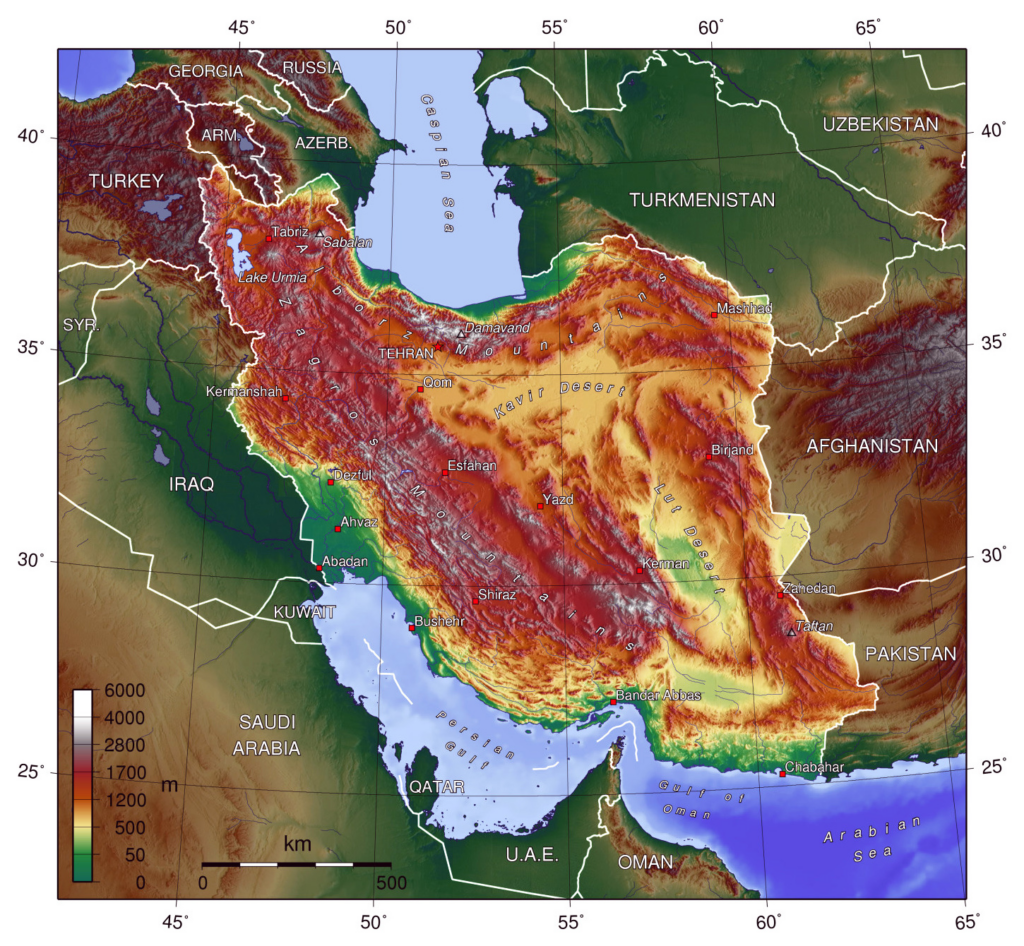
Let’s start with some comparatively recent military history. England, Germany and Vietnam are three countries where bombing them into submission was tried. It didn’t work. Germany actually managed to increase it’s war production in spite of Allied bombing. Subduing a country takes boots on the ground. That didn’t work out very well for us in Vietnam, Afghanistan, or Iraq. Won’t work in Iran either. Consider the geography of Iran in the map below.
There are a couple of things to notice. It’s between Iraq and Afghanistan. It’s very mountainous. According to AI, Iran is about 3.8 times the size of Iraq and 2.5 times the size of Afghanistan. Its population is around 90 million. The mountains, you can see, run all the way around its borders with Tehran sheltered in the middle and very hard to get to on land. Look at the terrain around the Persian Gulf and the Strait of Hormuz. Pretty easy to hide up in the mountains where you can’t easily be found and targeted by U.S air power and shoot missiles and drones at anything that goes through the Strait of Hormuz. It doesn’t matter that we’ve sunk the whole Iranian navy. And as long as you’re up in the mountains, you can target ships and U.S. bases in uh, well, a whole bunch of other countries as it turns out.
Afghanistan, by way of example, was first invaded by the Persians (no irony there) around 500 BC. In more recent history the British, the Russians and the Americans have all tried invading Afghanistan and failed. I don’t see how boots on the ground in Iran can succeed.
That brings us to economics. You have read that 20 million barrels of oil go through the Strait of Hormuz every day. Right now, damn few are getting through. Once you fill up your storage, stop pumping oil (or natural gas) and close down a pipeline things deteriorate. I don’t know much about petroleum engineering-make that nothing- but various sources make it clear that starting it up again isn’t just a matter of flipping the switch. Especially if it’s been hit by a Shahed drone that, according to AI, have ranges of between 435 and maybe up to 2,400 miles depending on the model. How long might energy infrastructure be closed down even if it’s not damaged by an attack? Weeks to month to longer depending on how long it’s been left not functioning and what it is.
The Persian Gulf is where Asian countries especially get most of their oil. Wonder how much they have in storage and when it will start to run out. The system by which we get our oil and gas products and all the products refined is complex beyond belief. There are different types of crude oil (high sulfur versus low sulfur for example) and gas that need to be collected, managed and refined differently to get all the products we make from them to the places they need to go. Not all refineries have the same capabilities. When one piece of this network is compromised the others are impacted as the impacts ripple through the system.
Here’s something you may not have considered. Oil comes out through the Strait of Hormuz. What comes back? A lot of food. The Persian Gulf states import 80% of their food. People tend to get cranky if they can’t get enough food. I forgot to mention that oil is used as a feed stock for making fertilizer, important for growing food. And now we’ve had some desalination plants that provide fresh water damaged. People also get cranky without water.
Culture. Iran’s population is Muslim, and most belong to the Shia branch, as opposed to the Sunni which is what most Arabs are. Remember the Iranians are Persian, and seem to want their empire back. The split between the Sunni and Shia happened when Muhammad died early in the 7th century. It was originally a dispute over leadership. The Iranian Shia have a strong religious hierarchy that has evolved over 1,300 hundred years or so. Senior clerics have serious authority. Shia Muslims believe that the Hidden Imam (the Mahdi) will return following major turmoil and injustice.
This is fundamental to who they are and how they think. Consider that Iran’s Supreme Leader, Ali Khamenei, was sitting in his house with members of his family and was killed on February 28 in one of the first strikes. He must have known the attack was coming, as did his family. But they were all sitting in their house except for his son, who has now been chosen as the new Supreme Leader.
It almost feel intentional. His son, Mojtaba Khamenei, now has an obligation to avenge his family. When I say intentional, if it was, I don’t mean “crazy.” I mean part of their belief system. If you are going to go to war with them, you’d better respect and understand that. I very much doubt Trump and his advisors did. We haven’t seen or heard from the new Supreme Leader, so it’s possible he was with the rest of his family and killed or wounded in the attack. Update- he’s has now (March 12) released a statement, but we haven’t seen him. Go read the statement. It’s not exactly the basis for the end of this war.
It may well be that much of the urban population in Tehran and other larger cities would like nothing better than to get rid of the religious hierarchy. The demonstrations that led to many deaths in Tehran would indicate this. But the part of the population outside those cities is intensely conservative and believes in their duty to confront and destroy the infidels. Kind of like what the difference was between Kabul and the rest of Afghanistan.
Militarily, it’s correct to say that the U.S. has control of the air and overwhelming traditional force available to it. But I’m wondering who’s going to run out of missiles first. I haven’t heard anything about success in destroying Iran’s ability to produce drones. Considering their shahed drones are said to cost around $50,000 and a patriot missile around $1 million (do you have to target the drone with two patriots to make sure of a hit?) something has to give. I know we aren’t just shooting them down with patriot missiles, but you get the point. The economics aren’t on our side and our ability to produce patriots, to stick to that example, is limited. Read this morning that we can produce about 700 a year right now. Wonder how many drones Iran can produce.
Go back and read the section on geography again. It doesn’t take many missiles or drones or mines targeting the Straight of Hormuz to keep it closed. That, indeed, is Iran’s strategy. Can we stop attacks there completely? Not sure we can. Meanwhile the government is religious/cleric dominated. They have had since 1979 to integrate themselves in the country’s power structure and economy. “Decapitation” may not work. If they truly believe they have a fundamental imperative to resist the infidels (that’s us) no matter the cost, our overwhelming advantage in fire power won’t be enough.
Before the war, but anticipating it, Iran created military districts each of which had discretion to prosecute the war at their discretion in case of a decapitation strike and loss of communications. Maybe that was how the attacks on countries housing U.S. facilities started. It was the act of a country that expects to keep fighting.
American assets in Persian Golf countries have been damaged or destroyed along with desalinization plants on both sides as well as oil storage facilities. Qatar has stopped producing natural gas. Iran’s willingness to strike so many other countries speaks, from my perspective, to Iran’s commitment and religious fervor. Yhey may have decided that keeping the Strait closed and the Middle East in turmoil is their only chance of “success,” whatever that means. They are right to believe that the world can’t allow the Strait to be closed too long.
This is a hell of mess, although one can say that about any war. It’s always the unintended consequences- the second and third level impacts that get you. Tragically, some of these consequences should have been foreseen- some, like the geography, just seem so obvious. They were, but nobody was listening.
Okay Jeff, if you’re so smart, what would you have done? Well, not started this war for one thing. Why not? I agree that Iran is dangerous. I agree they shouldn’t be allowed to have a deliverable nuclear weapon, though I distinguish between building a rudimentary bomb (info on the internet) and miniaturizing, hardening, and delivering it. I recognize their religious hierarchy feels compelled or required to “do jihad.” They are the leading supporter of terrorism in the world. And don’t forget the part about believing they should get the Persian empire back.
But since the Hamas attack on Israel Iran has been substantially weakened. Their economy is in a shambles due partly to sanctions. Some significant part of their population opposes the government. Hamas, Hezbollah and Syria who all acted as levers for projecting power towards the Mediterranean, are very much weakened. I might not have been quite as strident in negotiating a deal with them as the Trump administration has been. I would have referred them to the 12 day war last year and made it clear that was more of that to come if we didn’t reach an agreement and worked to get as many countries as possible to communicate to Iran that they get no nuclear bomb. Regime change would be nice, but I would not expect or demand it.
If the Strait of Hormuz can be reopened in fairly short order, this can be managed. If not we have a whole different level of problem. I recall then Secretary of State Colin Powell’s admonition to President Bush before the invasion of Iraq. He said, “If you break it, you own it.” Now known as The Pottery Barn Rule. Mr. President, you broke it- you own it.
Hi Jeff,
As always, thanks for sharing your thoughts. I’m not an expert on this either, but to me it feels like just another chapter in the long, complicated history between the US and Iran — this time, though, with a rather distinctive Trump stamp on it.
From what I understand, earlier US involvement in Iran—especially around the 1950s—helped create some of the instability that eventually led to the 1979 revolution and the current regime. So in a way, you could argue that parts of today’s situation are still fallout from past decisions.
As for why Trump took this step, it’s hard to explain or fully comprehend from a bystander’s pov . The nuclear argument seems too weak, as it is still debated how close Iran actually is to having a usable weapon. So what else is left to consider? Looking at Trump’s actions in general and the motivations behind them (there is still a lot of guesswork involved here), the reason might be less logical and less objective. Adding to that the impression that there is no real plan for this US war against Iran beyond the initial bombing, the possible explanation isn’t particularly convincing — maybe American–Israel lobbying and influence from key supporters and donors.
Even if some players see advantages (mostly Israel who else?), any escalation in that region risks much bigger global consequences, as we are already seeing — from oil and energy prices to effects further down many supply chains. This also seems to have dawned on Trump as well more recently, judging by his posts about the US’ negotiations efforts. Disruptions around the Strait of Hormuz alone affects pretty much everyone, even if countries like China or India might be slightly better positioned, with their tankers now being allowed to pass through.
Hi Flo. Great to hear from you. So, the Persians seem to want their empire back as I said in the article. I agree with you that Iran isn’t that close to being able to deliver a nuclear weapon. Enriched uranium is the first step. It seem they have that. Building a crude weapon is apparently not all that hard. But miniaturizing it, hardening it, and delivering it takes a lot more effort. Having said that, the concern is that the Shia religious bureaucracy is willing to take an awful lot of pain and believe they are on a mission from god or otherwise. They are proving it right now. What was Trump thinking? No idea. It would be like Venezuela? Just the threat would make the Iranians make a deal? That shock and awe would make them crumple? Not thinking at all? Most likely. This whole thing is part of a global realignment in politics, economics and force projection that is going on right now. Supply chains are being reconfigured in ways nobody could have foreseen and I don’t think it’s temporary. I hope Germany has the good sense to restart it’s nuclear plants. Don’t know if you heard, but last year 10 (just 10) front line Ukraine drone operators went to Estonia and conducted war games against two NATO brigades (one German and one Estonian). The Ukrainians apparently stomped the Nato troops. With ten guys and interconnected, coordinated drones because the Nato troops were fighting the last war. Too bad Trump didn’t know about that, although geography is a major reason Iran is being so successful.
I don’t like the Iranian theocracy. They are developing weapons and supporting other groups with a goal of controlling the Middle East. They’ve been at it a long time. I’d be very happy to stop them and would have considered using force. But I think I would have seen if not this particular outcome at least the possibility of it. As you say, the U.S. management of Iran over a long period of time is partly, though not entirely, responsible for some of this.
Thanks for the note.
J.